Wednesday, July 11, 2018

Chivalry

Many fraternal organizations use knightly imagery and pseudo-history to give them an air of legitimacy and to express their values.

A key concept of medieval chivalry and courtly love is choosing a more difficult path over an easier one. The more arduous journey is always to be preferred where the quest is concerned.

Consider the spiritual student who asks, "What is Cosmic Awareness?" What he's looking for (what he wants) is some easily digestible answer that he can easily absorb into his belief system.

But now consider how a Zen master might respond to such a question.

"What is Cosmic Awareness?"
"A rotting corpse thrown on top of a dung heap."

This is not the answer that the student was hoping for. What can possibly be meant by equating a sublime, eternal concept with one so revolting and corruptible?

In order to make any sense of this at all, the student will have to go away on his own and put in some real mental effort. And this is the point. A pat, comfortable answer proves nothing about the teaching or about the student. In each case, it's the student's effort that provides the real value.

A Zen koan is the opposite of a deepity. Whereas the deepity is a non-responsive phrase constructed to appear like an answer, the koan is an answer constructed to appear non-responsive.

There are a lot of deepities in spirituality but comparatively few real answers. Chivalry gives us pointers as to which we should choose and why.

Tuesday, July 10, 2018

Credere est inimicus fidei

Alan Watts observed that if you believe in God, then you don't really have faith. Believing in God means you're still clinging to something, whereas faith means totally letting go.

Belief in things like God or souls is actually easy to let go of, since those concepts are speculative. The hard part is letting go of beliefs about things that we're certain exist.

We know that life exists, consciousness exists. They invite beliefs about them which can be difficult to detach from. To look at a simple thing like a tree and say, "I don't know what that is" almost flies in the face of reason. And yet to say, "I know what that is" is to suggest that our conceptualization of reality has no limits, which is obviously false. Or is it?

Rosicrucian teachings suggest that our objective conceptualization has limits, but our subjective conceptualization does not. Our subjective conceptualization is part of a whole which is in itself an infinite absolute.

As an article of faith, this is debatable. But the only way to reach subjective conceptualization would be to acknowledge the limits of the objective.

The teachings themselves are like a tree. We have to say ourselves, "I don't what that is" in order to approach the inner alchemy that lies at the heart of the tradition. That inner alchemy, as described in The Chemical Wedding, may be less a transmutation than an obliteration. We can only know by not knowing.

Monday, July 9, 2018

The Friars of LRC

Lectorium Rosicrucianum (LRC) or the Universal School of the Golden Rosycross is a mystical organization which, unlike many Rosicrucian Orders of today, expressly operates as a religion (at least in some jurisdictions) and does have many characteristics of a Church. It has even been labeled a cult by some, particularly in France.

Having never been a member, I can't offer an insider's perspective. But I have watched a number of their youtube videos, and there are some things in their lectures which I find appealing.

For example, one of their lecturers compared the ego to a mirror, so that when you look at the world what you really see is not the world as it is, but a reflection of yourself. This is a view widely held within spirituality in general, and fits in nicely with my Zen outlook.

There are other things about LRC which mark them as being not only a spiritual school but a Church in their own right. They talk a lot about purification, and have very particular views about personal morality which do seem puritanical if not actually penitential (no drinking, no smoking, no eating meat, etc). These aren't bad attitudes per se, but in a way it seems to me that LRC members are basically expected to live as friars or uncloistered nuns, which is interesting in terms of Rosicrucian tradition.

I feel that Rosicrucianism is generally more nonconformist and less renunciate in outlook. Worldly pleasures might not be sought after as a means to a successful life, but neither are they considered doctrinally impure to my knowledge. Whether or not the lifestyle expectations LRC places on its members are enough to consider them a cult depends on who's doing the labeling, I suppose.

Saturday, July 7, 2018

First Neophyte Initiation

I have done my first Neophyte Initiation into CR+C. I won't detail the procedure or the exact thoughts I've written down to be sent to Imperator Gary Stewart. I wish to relate what, as a skeptic committed to non-attachment, the materials and initiation showed to me individually.

The Rosicrucian material, as I see it, is not so much a set doctrines which form the basis of a profession of faith. It does not constitute the teachings of a Church, but another source of illumination on who you might be and what you think, and the relationship you might seek between yourself and the world you encounter.

Even the most strict materialists are capable of awareness of mind, that is to say, capable of seeing reflections of themselves, of their self-conception, in other people and in nature. The source that you choose to attribute this awareness to, whether it be strictly the evolutionary processes which have shaped the organic brain, or the soul which you share in some sense with God and the whole of God's creation, you are capable of focusing that awareness for the better treatment of yourself and your surroundings.

The Rosicrucian teachings may be couched in a language which you find overly mystical or unscientific, or contrary to the dogma of a particular religion in which you were raised or to which you belong. Let go of that attachment and you will still be able to find meaning in them.

This is not only conducive to peaceful coexistence, but perhaps to a better cohabitation of your mind and your body, your passing thoughts, your convictions, and the autonomic functions that keep you alive. I can see where taking Rosicrucianism as a religion would lead to either accepting or rejecting it. But taking it as a philosophy of religion or philosophy of the body may lead to a more harmonious indwelling of its concepts.

The Rosicrucian tradition is expressed now in many orders, groups and among solitary seekers. There are many rooms in "my father's house" into which you may freely move and accommodate yourself. It is a path forward for humanity, and a better preference than the regressive paths which are offered to us as binary choices.

Pax et amor vobiscum

Thursday, July 5, 2018

Kill the Buddha

Some Rosicrucian organizations today offer complete, self-contained religious systems ; others offer a philosophy of religion rather than a religion itself. Either way, I think it's important to view all these teachings with detachment.

To paraphrase a famous Zen saying, if you meet Christian Rosenkreuz, kill him.

The Rose-Croix is an object of desire, but it's also a weapon to kill that desire within those who seek it. "I did not come to send peace, but a sword."

Monday, July 2, 2018

Göbekli Tepi

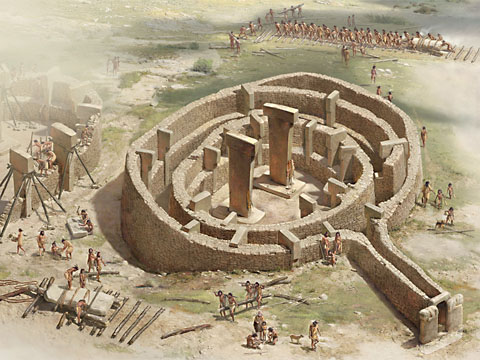
For many years, archaeologists and anthropologists theorized that the development of agriculture led to larger human settlements and in turn to the evolution of complex religious rituals and temple and funerary constructions. But the revelation of the neolithic ruins at Göbekli Tepi turned this theory on its head.

Göbekli Tepi
At this site, hunter-gatherers who still subsisted on a diet of wild grains and undomesticated prey animals had gathered in sufficient numbers and developed a sufficiently rich religious system to allow for the building of large stone structures consecrated to purely to symbolic activities. This discovery led to the theory that it may have been the rise of complex religious activities that drove the development of the agriculture necessary to continue supporting them, not the other way around.

It has also been observed that, in contrast to earlier cave art from Stone Age peoples, which seem to depict the power of nature as supreme, the ruins at Göbekli Tepi evidence a shift in human consciousness. It is now man who is at the center of the world. No longer merely a small part of the natural world, as his ancestors had been, man had begun to see himself and his awareness as extending throughout nature, influencing and guiding it in service to himself and the otherwordly powers he believed in. Man had begun to regard himself as a chosen species, elevated above all others, both materially and spiritually.

I will reference once again the myth of Adam and Eve, in which God tells Eve that henceforth she will be placed under Adam and he will be her master. If Eve represents nature herself, we can view this story as a Bronze Age echo of that first Near Eastern awakening millennia earlier among the people of Göbekli Tepi.

In the Rosicrucian tradition, the Book of Nature is seen as another Gospel, one written by God's own hand, whose esoteric mysteries are to be sought out and examined by those who wish to raise their spirits toward a closer union with the divine. Nature contains "secret sayings" as the author of the Gospel of Thomas might have put it, and salvation depends upon understanding what those sayings are telling us. Faith alone is not enough. Sacramental religion alone is insufficient. Study, meditation and deciphering one's own internal mythology as it mirrors the exterior world is necessary to achieve the fullest possible reintegration.

This is the path that Rosicrucians and the people of Göbekli Tepi before them have laid before us. It is up to each of us to take up the cross and follow them.