Showing posts with label rosicrucian. Show all posts

Friday, December 14, 2018

The First Rosicrucian

I googled "first rosicrucian" and the first like that popped up said "Understanding reincarnation" which leads me to the topic of today's post: Pythagoras.

He is primarily remembered today for his theorem concerning right triangles, but the history (mostly mythology, actually) of Pythagoras goes much deeper than that.

As a seeker of knowledge, he did not seem to distinguish between empirical and mystical ideas, and he was said to have been very keen to learn from cultures older than his native Ionian Greek civilization. Hence he traveled to Egypt and, it is claimed, to India.

An Indic concept of reincarnation first enters recorded western thought through the Pythagoreans, along with the concept of the monad or brahman as the source of all creation. If Pythagoras was not a real, historical individual, it certainly seems that the character must have been based on one or more real people who were exposed in some depth to the Vedic tradition and brought its ideas back to the West - kicking off a cycle of historical and legendary Westerners periodically "rediscovering" the knowledge of the East, from Pythagoras to Christian Rosenkreuz to Mme. Blavatsky to the Beatles.

Friday, July 13, 2018

Divine Immanence

Many Neopagans and Rosicrucians share a belief in divine immanence or pantheism, the idea that God is present in everything that exists. But broadly speaking, the two groups differ on how they think we should approach or connect with the Divine.

If it can be said that there's a default Neopagan view on the subject, it could probably be expressed as a feeling of awe or reverence for the Divine in nature, whereas the Rosicrucian view typically follows Spinoza and his rejection of this kind of religiosity.

Spinoza felt that such reverential attitudes could easily lead to erroneous and superstitious beliefs and practices, and argued that the way we should connect with the Divine was through an intellectual understanding and appreciation of its perceptible modes of existence. The Rosicrucian call to "read the book of nature" is in line with this view.

Of course, in reality, the division is a lot fuzzier. But as a philosophical matter, the distinction may be important, and the prevailing culture within each tradition may account for why people choose to identify as one or the other.

Tuesday, July 10, 2018

Credere est inimicus fidei

Alan Watts observed that if you believe in God, then you don't really have faith. Believing in God means you're still clinging to something, whereas faith means totally letting go.

Belief in things like God or souls is actually easy to let go of, since those concepts are speculative. The hard part is letting go of beliefs about things that we're certain exist.

We know that life exists, consciousness exists. They invite beliefs about them which can be difficult to detach from. To look at a simple thing like a tree and say, "I don't know what that is" almost flies in the face of reason. And yet to say, "I know what that is" is to suggest that our conceptualization of reality has no limits, which is obviously false. Or is it?

Rosicrucian teachings suggest that our objective conceptualization has limits, but our subjective conceptualization does not. Our subjective conceptualization is part of a whole which is in itself an infinite absolute.

As an article of faith, this is debatable. But the only way to reach subjective conceptualization would be to acknowledge the limits of the objective.

The teachings themselves are like a tree. We have to say ourselves, "I don't what that is" in order to approach the inner alchemy that lies at the heart of the tradition. That inner alchemy, as described in The Chemical Wedding, may be less a transmutation than an obliteration. We can only know by not knowing.

Monday, July 9, 2018

The Friars of LRC

Lectorium Rosicrucianum (LRC) or the Universal School of the Golden Rosycross is a mystical organization which, unlike many Rosicrucian Orders of today, expressly operates as a religion (at least in some jurisdictions) and does have many characteristics of a Church. It has even been labeled a cult by some, particularly in France.

Having never been a member, I can't offer an insider's perspective. But I have watched a number of their youtube videos, and there are some things in their lectures which I find appealing.

For example, one of their lecturers compared the ego to a mirror, so that when you look at the world what you really see is not the world as it is, but a reflection of yourself. This is a view widely held within spirituality in general, and fits in nicely with my Zen outlook.

There are other things about LRC which mark them as being not only a spiritual school but a Church in their own right. They talk a lot about purification, and have very particular views about personal morality which do seem puritanical if not actually penitential (no drinking, no smoking, no eating meat, etc). These aren't bad attitudes per se, but in a way it seems to me that LRC members are basically expected to live as friars or uncloistered nuns, which is interesting in terms of Rosicrucian tradition.

I feel that Rosicrucianism is generally more nonconformist and less renunciate in outlook. Worldly pleasures might not be sought after as a means to a successful life, but neither are they considered doctrinally impure to my knowledge. Whether or not the lifestyle expectations LRC places on its members are enough to consider them a cult depends on who's doing the labeling, I suppose.

Thursday, July 5, 2018

Kill the Buddha

Some Rosicrucian organizations today offer complete, self-contained religious systems ; others offer a philosophy of religion rather than a religion itself. Either way, I think it's important to view all these teachings with detachment.

To paraphrase a famous Zen saying, if you meet Christian Rosenkreuz, kill him.

The Rose-Croix is an object of desire, but it's also a weapon to kill that desire within those who seek it. "I did not come to send peace, but a sword."

Saturday, June 30, 2018

Seeking Eternity

Wise are those who seek eternity in the moment

This sounds like a typical Zen aphorism, but I think it makes sense hermetically too. According to the principle of correspondence, the eternal character of a higher plane should correspond to the transient nature of life as we know it.

If eternity can be described as timelessness, then it corresponds to a moment of "no time", i.e. the present. Eternity is without past or future. The fullness of time corresponds to the emptiness of Zen.

We cannot directly experience eternity, but we can experience its mirror image. In meditation we can encounter moments of no time, a shadow of permanence that passes as soon as it is realized.

Friday, June 29, 2018

CR+C Membership

Good news. I will soon start receiving monographs from CR+C, so I will be able to remedy some of my ignorance about the Lewis tradition within Rosicrucianism.

A word about why I chose CR+C instead of AMORC. It has nothing to do with AMORC as an organization or its members. I have enjoyed learning about both groups. But to my understanding, CR+C offers monographs that are less altered from the versions as originally proffered by H. Spencer Lewis. It's not that I think AMORC's current monographs have less objective value, but if there's any reinterpretation of the material to be done, I would rather work that out myself from my perspective as a mythicist and as someone pursuing my own personal tradition.

Secondly, having listened to Ralph Lewis giving various talks, I have a good opinion of his earnestness, and I know Gary Stewart was Lewis' choice to be the next custodian of the material.

I look forward to this next phase in my education.

Flower of the Golden Union

Lonnie Edwards, M.D. of AMORC has discussed the notion that we live our corporeal lives because our souls chose to experience the journey of mortal existence. I don't pretend to know anything about souls, but the idea does present an interesting interpretation of the fable of Adam and Eve.

Instead of being a story of paradise lost, it might be seen as a myth of two angelic beings who chose to experience mortal lives.

Flower of the Golden Union
In the above hieratic script, read from right to left, the word for flower is written with the two snake-like letters. The Serpent, instead of being cast as a deceiver who tricks the two lovers into giving up their immortality, can be seen as a symbol of regeneration and renewal.

The snake sheds its skin, and winds through the world like a life-giving river. Here he convinces Adam and Eve to shed their old lives and enter the world of mortals together, not to drive them away from God, but to help them better understand him through experiencing divine creation in new ways.

Every myth can have more than one meaning. And while I may not share all of Dr. Edwards' beliefs, I think Rosicrucianism is more about finding synchrony than similarity.

Tuesday, June 26, 2018

De Religione Catharon

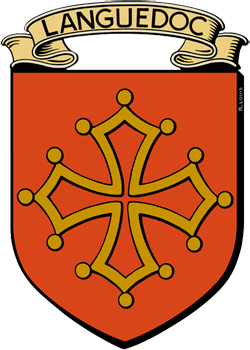
Maurice Magre was a French author from Toulouse, a contemporary of H. Spencer Lewis and a fellow student of mysticism. Magre held a romantic view of the history of his native Languedoc and the persecution of medieval Cathars in that region.

He developed a notion that C.R.C. was a scion of a Cathar family, and that he and his earliest Rosicrucian brethren were educated in that religion, but this seems a little far-fetched to me.

The Cathars held a dualistic view of creation, and thought renunciation was essential to escape the hateful material plane once and for all. This is a far cry from elevating nature almost to the status of co-redeemer as the Rosicrucians did.

The Cathars may have interpreted Christian resurrection as a kind of repetitive reincarnation, with final escape from material existence only being possible once the soul has reached a certain level of maturity over multiple lifetimes, and that's not dissimilar per se to some Rosicrucian teachings and those of other spiritual movements. But a vague similarity doesn't establish a plausible link.

For the Cathars, nature was not a divine classroom but an infernal prison, and the Rosicrucian manifestos just don't share that same general outlook.

Saturday, June 23, 2018

Speaking In Tongues

Χριστος (Christos) means the Anointed One, and was the basis for the original Christian symbol, the juxtaposed Chi-Rho. By this sign, early Christians could identify themselves both as followers of a particular Anointed One, and as anointed ones themselves.

Anyone who has been through the sacrament of baptism is an anointed one, an initiate of the Christian Mysteries — which is exactly what they were in the early years of what is called the Common Era. (I actually prefer Anno Domini, because at least that doesn't try to evade the question of where, which is to say from what religion, the western dating system comes from.) Christian initiation came to literally embody the journey from birth to death, and an initiation into Christian mysticism became an enlightened journey starting at a spiritual rebirth, one which took place, at minimum, at the age of majority.

The Chi-Rho symbol may have also been widely recognized in the Roman era as a figurative representation of a person on a cross, if Simcha Jacobovici is correct in his theory that Roman crucifixion was actually done using x-shaped crosses instead of t-shaped ones. Today the Chi-Rho can still be seen in liturgical use even in the shadow of the crucifix which has since been transformed into its more recognizable image.

Though Christianity is still occult in many practices, as anyone who has been to a Tridentine Sacrifice of the Mass can attest, it has also positioned itself as the enemy of occultism the further it has moved away from being a secretive fraternity. Christianity, in effect, has long since become a religion, not a brotherhood. Apart from much ballyhooed examples of masonic messages preserved in stone and stained glass, Christianity's metamorphosis has taken it from hidden meaning to a common faith of uncommon language.

Yet at the crucible point of Lutheranism, Rosicrucianism arose to simultaneously call for universal reformation and to cloak its summons in the language and symbolism of elite learned men. What can be made of this seeming contradiction ?

In the 17th century, Latin — not the languages of Germans, or Huguenots, or the English Reformation, or Muslims or Chinese for that matter — was still the language by which "proper learning" was transmitted. Publishing in Latin was a way of proclaiming "this is legit," and it still is in some cases. If you've ever heard the name of tyrannosaurus rex, you probably see what I mean.

Liberatio per artem et scientiam — liberation through art and knowledge. If I were to start a Rosicrucian Order of my own, this might be its motto. For those of us in the West, "science" is the term we use to describe that which can be known ; "art" is the term by which we describe that which could not otherwise be known.

Another word I like, which could be described as a translation of "Rosicrucian" (though perhaps by no one but me) is 芸者 (geisha) — one whose entire life could be described as an ongoing work of art.

If the term Rosicrucian does not describe someone of continual seeking and learning and absorbing things foreign to them, and expressing those thing in multiple esoteric and exoteric ways, then I don't know what it means.

Bride of Achilles - The Heroine's Journey

I would like to refer back to The Pansophy Secret Behind Western Initiation in which Samuel Robinson discussed the hero's loss of his phallic symbol and its restoration by the goddess. My question is : What if the hero is a heroine instead ? She has no phallus to lose, though she could be (re-)united with one in the form of a god.

To be clear, my purpose here is not to dispute the pansophic view of universal western initiation, which I don't disagree with. Rather, I wish to propose a complementary symbolic scheme which I think also relates back to mythic precedent.

The basic Rose-Croix image can be seen as symbolic of the union between masculine and feminine, and we have in Christianity, for example, St. Teresa of Avila and her desire to be pierced by the arrow of God's love. But what of older civilizations that have informed the western tradition ? I believe the concept does ultimately derive from them, though it was often the case that such stories were told from the point of view of masculine desire (and abduction/rape of the object of that desire) rather than from the perspective of the feminine desire to be taken.

First we have the myth of Persephone, apparently a key figure in the Eleusian mysteries. She is abducted by Hades (or runs off with him to become the queen of the underworld?) thus passing into death and being reborn in new life, both in the form of the Earth's fertility and, in some versions, giving birth to divine offspring. There is also the example of Helen of Troy, abducted by or running off with Paris, suffering "death" at the hands of Orestes and Elektra, but in fact taken up by Apollo to dwell in the heavens. Then we have the story of Iphigenia, who goes to her supposed wedding only to face immolation at the hands of her father (Elektra complex, anyone?) but who is miraculously saved from death to be transformed into a goddess or into the bride of alpha male Achilles in the afterlife.

For me, these stories illustrate the concept of a Heroine's Journey, of a seeker who doesn't start her path missing a link to the feminine and needing to be made whole by it, but rather the opposite.

The examples are not limited to ancient Greece, either. In Egyptian lore we can look at a goddess like Sekhmet, a destructive "lost soul" who's knocked out for three days, after which she achieves reintegration with the divine realm when she wakes and falls in love with a creator god. It's known that Sekhmet's journey was celebrated with temple rites and associated with healing magic.

In ancient times, women had their own mystery schools, presumably designed for and according to their own inner journeys. The Bacchae would go up into the hills and do whatever it is they did, with a strict "no boys allowed" policy. In the Christian era, self-initiation became virtually the only path open to female esoterics, buoyed on the back of a convent education or simply by local folklore.

In the modern age, some women have gravitated back toward a segregated paradigm centered on communing with their own femininity, while others have embraced a more gender-inclusive mysticism, but one originally engineered by men for the purpose of reaffirming goddess-knowledge as part of the path to salvation. The pursuit of reintegration through a Christ figure who has not been desexed has not, to my knowledge, been a focus of widespread attention, but it's one I've long felt an attraction to, and I hope this post has shed some light on it.

Thursday, June 21, 2018

How much esotericism is too much ?

We're all "initiated" into a general cultural knowledge base, and then into progressively more narrow knowledge bases as determined by education level and group affiliations. So we all have some degree of esoteric knowledge, i.e. knowledge that not everyone else possesses.

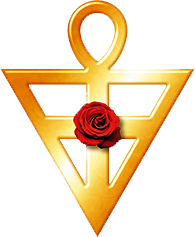
Some esoteric symbols (for example, the AMORC Rose-Croix-Ankh-Pyramid design on the left) are vague enough to be appreciated for aesthetic reasons, and for individuals to project their own personal meanings onto them. You don't have to be a high-degree initiate of AMORC in order to make something out of that symbol, even if you don't know precisely what the initiated have learned about it.

On the other, consider the Rose-Croix design on the right. It's esoteric symbolism is more detailed, and thus more impenetrable to outsiders. It's less likely to be adopted by someone who just came across it on the internet and liked how it looks. You'd want to know what all the stuff on there actually means.

That might serve as an enticement to join a fraternal organization that promises to reveal its mysteries to you, but it might also make that organization's membership suspect. Putting yourself out there as part of a secretive, select group can make you a target for conspiracy theories and charges of elitism.

Wearing a shirt with E=mc² on it says one thing about you ; wearing a shirt with string theory equations on it says something else.


Both the esoteric cross and the esoteric equation communicate specific information, but only to the elite who have been inducted into the Great Mysteries. Who knows what they're really up to behind closed doors ?

That's the question the uninitiated will always ask themselves, and the answer usually isn't anything good for the initiates. Mystery schools still have to walk a fine line between exciting interest and inciting envy.

Sunday, June 17, 2018

Welcome

Welcome to the blog of the Zen Rosicrucian. What is that, you may ask ? In short, it is the practice of zazen in contemplation of Rosicrucian symbolism.

The original Rosicrucian manuscripts of the 17th century combined anti-authoritarian Reformist Christianity with esotericism, syncretism and spiritual alchemy, whereas the prominent Rosicrucian fraternal organizations of today, such as AMORCCR+C and SRIA incorporate a broad focus of structured study and practice largely revolving around concepts that were trendy in the Edwardian era (Egyptology, Atlantis, examination of psychic phenomena).

As a Zen Rosicrucian, I practice a more minimalist approach, according the maxim Calix iam plenus replevit non potest, or "you can't refill a cup that's already full". Through simple meditation on Rosicrucian imagery, I try to empty myself and allow my conscious and unconscious minds to explore the symbolism as they will, treating that symbolism, after a fashion, as a form of Zen koan.

If this concept intrigues you, I invite you to read further.

How do I practice ?

Typically, I set up my small Rosicrucian altar, fill the brass bowl with water, light candles and incense and, seated before the altar in typical zazen fashion, I mediate quietly, allowing my thoughts to flow freely. Afterwards, I take the bowl to the sink and use the water for a post-meditative ablution.

This ablution was added at the suggestion of my Neopagan sister-in-law, who says it improves my aura. I don't know whether this is true, but I like it as a calming and cleansing way to conclude my practice.

What I hope to experience generally during meditation is a sense of inner joy, as Buddhists might put it, but this doesn't always come to me. However, it's important not to have too much attachment to any particular goal. In sese ire est ire extra tempus — to go into yourself is to go outside of time, to escape your own drives and thus meet yourself in a state of renewal.

I hope you've enjoyed this introductory post, and hopefully more will accrue.