Tuesday, July 17, 2018

Shaivism vs. Vaishnavism

As someone who's not Indian, my exposure to Indian religion is mostly through incarnations of Vishnu. I'm also drawn to solar deities, and Vishnu fits nicely into that. Plus there's the fact that I'm not an ascetic. I have a household, and that seems to fit in better with Vaishnavism.

On the other hand, my experiences (limited though they are compared to those of someone who's continually devoted to the path) seem more similar to those of Shaivism. My general perspective seems more oriented toward Shiva, even though Shiva is quite alien to me.

The question of whether I'm engaged in worship in my practice is not one that I have a clear answer for. And I have these questions about Shiva and whether Shiva is somehow part of my work, a hidden aspect behind the scenes.

Sunday, July 15, 2018

Freudian Spirituality

Áine Órga has an excellent series on developing a personal spiritual practice, figuring out what your concept of divinity and awareness is, and so on. I would say an equally important question is "What are you into sexually?"

A lot of spiritual seekers are drawn to Jung, but I think sufficient attention should be paid to Freud as well, because Freud was right about one thing : sexuality infuses every part of our psychical being.
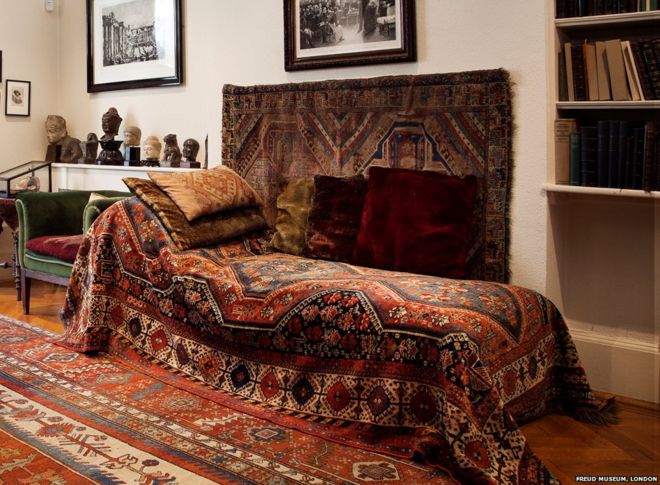
How do you feel about your mother?
When developing a personal practice, you are necessarily putting yourself on Freud's couch, so to speak, and working through all the ways in which your sexuality influences your ideas about your own being, about the world, about gods and religion, and the ways you connect with others. It influences what you really want from spirituality and how you're going to go about getting it.

Our rapidly changing sociopolitical environment leads a lot of people to seek out alternative spirituality. But if your sexuality doesn't really align to particular tradition, you're not going to get much out of it even if it appeals to you on intellectual principle.

Over the years, when I've lurked and occasionally posted on alternative spirituality forums, I've noticed a strong trend among those groups toward toward incorporating the Divine Feminine back into their consciousness and their lives. There seems to be a common assumption that the reason people seek out alternative spirituality is because that feminine aspect has been neglected by the western tradition, that the Patriarchy is the a priori reason why new and reconstructed traditions exist in the first place. This is true even in the nominally Christian-based Rosicrucian tradition, with its call to reintegrate with Divine Sophia. But as I alluded to in my post on The Heroine's Journey there isn't a "one size fits all" raison d'être for alternative seekers.

A question could be asked whether the continued predominance of traditional religion is not due, at least in some small part, to the fact that many people still feel more at home in it psycho-sexually than they would feel in alternative spirituality. If their cognitive dissonance resolves itself by siding with the unconscious sexual appeal of male dominance, they will stay put rather than taking the plunge into a tradition that's more in line with their actual philosophical perspective in the modern world, but which leaves them cold when it comes to their deepest sexual urges.

Needless to say, I think this is a false choice. Developing your own practice that is philosophically harmonious is much preferable, I think, even if it's driven by a desire for the Divine Masculine that isn't considered trendy in alternative circles.

No Agenda

While I was meditating last night, I thought of the phrase "You will realize by doing nothing that everything is already done."

In Latin it could be : Nihil agendo senties ut omnia iam fiant

I like this formulation because it uses the etymological root of our word agenda. The proper mindset is to have no agenda, just practice.

Saturday, July 14, 2018

Personal Altars

The youtuber Áine Órga has some excellent videos about designing a personal altar, and the reasons for her own choices.

She's had a Buddha statue on her altar at times even though she's not Buddhist, and it seems this led to some discussions about cultural appropriation and why she had it there.

Personal altars are about personal symbolism. It's not about what the wider world thinks the "authentic" meaning of the symbolism is, but about what it represents to you.

My own eclectic altar could be very misleading if you take it at face value. The cross doesn't represent Jesus, the triple moon goddess doesn't represent a typical Neopagan understanding of that figure. They're personal symbols and therefore it would be wrong to assume they mean what someone else thinks they mean.

Although the Rosicrucian cross usually has four arms of equal length, and there are symbolic reasons for that, mine doesn't — and there are symbolic reasons for that too. Mine is more masculine and phallic in design, because that's a presence I like to connect with. The triple moon goddess is me, more or less, the seeker. She represents union with the masculine presence. It has to with my own inner alchemy, and not some "objective" meaning that somebody else might try to discern.

The world is more interconnected than ever before, so people are bound to come across images from outside their nature culture(s) that speak to them. All that matters is that they get some personal value from it.

Friday, July 13, 2018

Divine Immanence Part 2

I identify more with rationalism than reverence, so I can critique Spinoza's puritanical rationalism as being unrealistic. It's a bit like asking someone to connect with their child only through intellectual appreciation of the qualities of juvenile humans.

Feelings are bound to come into it, even if they're messy and make us prone to error. Hence there's no stark dividing line, but more like general trends in self-identification based on what first comes to mind when we discuss attitudes toward divinity in nature.

I think Neopagans are more likely to place reverence or even worshipful attitudes toward nature front and center when trying to put a finger on what draws them to that tradition and that label. Rosicrucians sometimes also express reverence for nature, but that tends to be less central to the practice than natural and spiritual philosophy.

"How great thou art, Mother Nature!" is not the usual Rosicrucian M.O. Rather than devotional feeling, I think we find the ever-evolving code of the universe to be awe-inspiring in its complexity, and try to understand its fundamental rationality so that we can bring our own inner beings more in harmony with its laws. Of course, this is still very generalized, and not applicable to all Rosicrucians any more than pantheism is applicable to all Neopagans.

I find my own practice straddles the fence, and involves something more like a personal god-concept, as I alluded to in my post on The Heroine's Journey even though I don't believe in a personal god as an actual entity.

To engage in finely-parsed syntax as Spinoza was wont to do, you might say that I'm a Neopaganesque Rosicrucian rather than a Rosicrucianesque Neopagan. Or to put it in quantum terms, the dividing line becomes more difficult to pin down the harder you look at it.

Divine Immanence

Many Neopagans and Rosicrucians share a belief in divine immanence or pantheism, the idea that God is present in everything that exists. But broadly speaking, the two groups differ on how they think we should approach or connect with the Divine.

If it can be said that there's a default Neopagan view on the subject, it could probably be expressed as a feeling of awe or reverence for the Divine in nature, whereas the Rosicrucian view typically follows Spinoza and his rejection of this kind of religiosity.

Spinoza felt that such reverential attitudes could easily lead to erroneous and superstitious beliefs and practices, and argued that the way we should connect with the Divine was through an intellectual understanding and appreciation of its perceptible modes of existence. The Rosicrucian call to "read the book of nature" is in line with this view.

Of course, in reality, the division is a lot fuzzier. But as a philosophical matter, the distinction may be important, and the prevailing culture within each tradition may account for why people choose to identify as one or the other.

Thursday, July 12, 2018

Horizonal Spirituality

Spirituality is often assumed to be ontological. It's assumed to have something to say about the true nature of being. It's assumed to involve concepts, whether natural or supernatural, which we may not be able picture in our minds, but which we can discuss in the abstract.

I propose the term horizonal spirituality for a spirituality based on perception.

Although I'm familiar with the concept of infinity, if I try to picture in my mind an infinite number of coins or an infinite number of elephants, I find that I can't. I can only picture something that fits into a finite horizon. If I can't picture something, I can't perceive it ; and if I can't perceive it, I must doubt its existence.

Perception here isn't limited to physical sensation, or to things which actually exist. I can picture someone halfway around the world. I can picture Superman flying. I can even picture the entire universe, if I picture it squeezed into a very small space, or a subatomic particle if I picture it magnified many times. In this sense, I can perceive these things. But I can't picture a maximally perfect infinite being. This is something that doesn't fit within my functional mental horizon.

Horizonal spirituality, then, is not concerned with the God that Anselm of Canterbury and his ontological successors attempted to prove through logical reasoning, but it's not necessarily anti-theistic. Rather, it's iconic in that supernatural beings that come in discreet forms can be part of it, as can other images or items that you might place on an altar and focus your attention on. It can be pantheistic or naturalistic, it's just not concerned with concepts which are fundamentally imperceptible.