A google search for Scientology/AMORC will turn up a thread from nine years ago, started by an atheist skeptic, and asking whether AMORC is just a cheaper/low-pressure version of Scientology.
I'm only a 1st degree initiate of CR+C and I've never been a Scientologist, although I've followed the ex-Scientologist movement from afar. So I'd like to give my own brief take on what I perceive to be the similarities and differences.
Similarities
Both groups posit certain ideas about the nature of the human being, the soul, immortality and paranormal experiences.
Differences
CR+C does not have a "fee per service" model. There are membership dues, as you would expect from any fraternal organization, country club, etc. These amount to US$25 quarterly or US$35 for a "plus one" companion membership for two people living at the same address. Payments can be made through PayPal for your security. Included at no additional cost are study materials mailed to you quarterly. Membership is reserved to people aged 18+ and no restrictions are placed on your religious beliefs or other associations, be they personal, professional or political.
The cost to do all twelve degrees of AMORC/CR+C initiations would run you less than US$1000. Compared to what I've heard about the total cost of getting to OT VIII in Scientology, that's a drop in the bucket. And that doesn't even begin to address the differences between Scientology's (alleged) child abuse, financial fraud and "disconnection" policy as compared to AMORC/CR+C which engage in none of those things.
In conclusion, while many people might say that both sets of teachings amount to spiritual nonsense, and that's fine, I can't help but think there's no moral or ethical similarity between Scientology and these two Rosicrucian Orders.
Wednesday, July 25, 2018

Atlantis through the eyes of Egypt
Continuing my faux archaeological exploration of Atlantis, here is a papyrus fragment from the Middle Kingdom which details a slightly different version of the myth.

The god of the sea is their father, and the divine bull is his son. When the world was in darkness, the people were afraid. They lived in caves as those who hunger. Then did the divine bull offer himself as a sacrifice for their sake, and he was reborn as the sun.
This is meant to allude to a stone age era of cave dwelling humans, and the myth of their salvation through the creation of the sun, which in this case represents the coming of "light" in the broadest sense. The primitive cave dwellers emerge from the stone age, achieve greater knowledge of the world and greater technological and spiritual advancement, and this is credited in a religious sense to the voluntary sacrifice of the most holy creation.
Saturday, July 21, 2018
Atlantis Creation Myth
This is an invented fragment of an Atlantean creation myth, again done with Greek and Linear B script.My idea is that it's part of a later compilation, and so draws from multiple sources. Thus, like real mythological texts, there's a contradictory doublet. Enjoy.

When the woman came out of the sea, riding a bull, the land was empty and without life.
And the stars, looking down, desired the woman, and shot arrows and slew the bull.
Therefore the sun banished them to the far sky to drift forever.
But one among the stars did not shoot an arrow, who is called the North Star and the Faithful One.
Now the woman mourned the death of the bull, and the sun pitied her. So the sun sent forth a wise serpent, and the serpent said, "Do not weep, for the bull is not truly dead, but from his blood shall come life." And the land became fertile.
Then the woman gathered seashells, and she opened them, and out of them came living things of every kind to fill the land.
So the sun caused living things to fill the Earth, and he said, "It is not good for the woman to be alone." He told her to take one of the arrows that had slain the bull and throw it into the sea. And there man emerged.
Friday, July 20, 2018
Atlantis Calling
It seems that all mystics worth their salt have come up with some kind of pseudohistory about Atlantis. Of course, nothing has ever been found to verify any of it. But I thought I'd throw my hat in the ring and present the closest possible reconstruction of Atlantean language.
For the words themselves, I used Greek, or conjecture about Indo-European roots for ancient Greek. Then I transliterated the phrase into Linear B script, the oldest alphabet from the Achaean and Minoan civilizations which has been thus far been deciphered.
So imagine that you're on Atlantis for the winter solstice festival, and as you make your way into the sacred grounds of the sun temple, you see the following inscription.
 |
| The sun is the light of divine perfection within you |
Thursday, July 19, 2018
CR+C Exercise
 One of the exercises of the first Neophyte degree in CR+C basically involves awareness of and directing Spirit Force (or Chi, or whatever you prefer to call it).
As usual when doing these exercises, I go into it with no expectations. Nor do I do meditation exercises by the book, in terms of the H. Spencer Lewis method of sitting comfortably in a chair. On this occasion, I did about ten minutes of yoga followed by zazen, and nothing really happened. About an hour or two later, I did ten minutes of yoga again followed by meditation, and I experienced exactly what was described in the monograph.
This kind of justifies my decision to do these studies, because I'm not really looking for doctrinal ontological answers. I'm looking for experiences which broaden my perspective and give me new things to contemplate. So I consider this a success which I owe to the tradition.
Once I experienced what I immediately perceived as something the monograph said I might feel, I continued the meditation and experimented with it further, and continued to experience the same effect when I directed my thoughts to other parts of my body. There was no sense of resistance. It was quite pleasant.
After I was done experimenting with it, I just let my mind go. Immediately in undirected meditation I had the impression of a gently rolling sea, a clear blue sky and the sun shining, which reminded me of a Vishnu-esque scene.
So I'm still left with questions as to whether my practice has a devotional subtext (related to God in some form) or if it's just mental/self-oriented which is how it's set up to be. I don't feel any need to really answer this question.
Tuesday, July 17, 2018
Shaivism vs. Vaishnavism
 As someone who's not Indian, my exposure to Indian religion is mostly through incarnations of Vishnu. I'm also drawn to solar deities, and Vishnu fits nicely into that. Plus there's the fact that I'm not an ascetic. I have a household, and that seems to fit in better with Vaishnavism.
 On the other hand, my experiences (limited though they are compared to those of someone who's continually devoted to the path) seem more similar to those of Shaivism. My general perspective seems more oriented toward Shiva, even though Shiva is quite alien to me.
The question of whether I'm engaged in worship in my practice is not one that I have a clear answer for. And I have these questions about Shiva and whether Shiva is somehow part of my work, a hidden aspect behind the scenes.
Sunday, July 15, 2018
Freudian Spirituality
Áine Órga has an excellent series on developing a personal spiritual practice, figuring out what your concept of divinity and awareness is, and so on. I would say an equally important question is "What are you into sexually?"
A lot of spiritual seekers are drawn to Jung, but I think sufficient attention should be paid to Freud as well, because Freud was right about one thing : sexuality infuses every part of our psychical being.
When developing a personal practice, you are necessarily putting yourself on Freud's couch, so to speak, and working through all the ways in which your sexuality influences your ideas about your own being, about the world, about gods and religion, and the ways you connect with others. It influences what you really want from spirituality and how you're going to go about getting it.
Our rapidly changing sociopolitical environment leads a lot of people to seek out alternative spirituality. But if your sexuality doesn't really align to particular tradition, you're not going to get much out of it even if it appeals to you on intellectual principle.
Over the years, when I've lurked and occasionally posted on alternative spirituality forums, I've noticed a strong trend among those groups toward toward incorporating the Divine Feminine back into their consciousness and their lives. There seems to be a common assumption that the reason people seek out alternative spirituality is because that feminine aspect has been neglected by the western tradition, that the Patriarchy is the a priori reason why new and reconstructed traditions exist in the first place. This is true even in the nominally Christian-based Rosicrucian tradition, with its call to reintegrate with Divine Sophia. But as I alluded to in my post on The Heroine's Journey there isn't a "one size fits all" raison d'être for alternative seekers.
A question could be asked whether the continued predominance of traditional religion is not due, at least in some small part, to the fact that many people still feel more at home in it psycho-sexually than they would feel in alternative spirituality. If their cognitive dissonance resolves itself by siding with the unconscious sexual appeal of male dominance, they will stay put rather than taking the plunge into a tradition that's more in line with their actual philosophical perspective in the modern world, but which leaves them cold when it comes to their deepest sexual urges.
Needless to say, I think this is a false choice. Developing your own practice that is philosophically harmonious is much preferable, I think, even if it's driven by a desire for the Divine Masculine that isn't considered trendy in alternative circles.
A lot of spiritual seekers are drawn to Jung, but I think sufficient attention should be paid to Freud as well, because Freud was right about one thing : sexuality infuses every part of our psychical being.
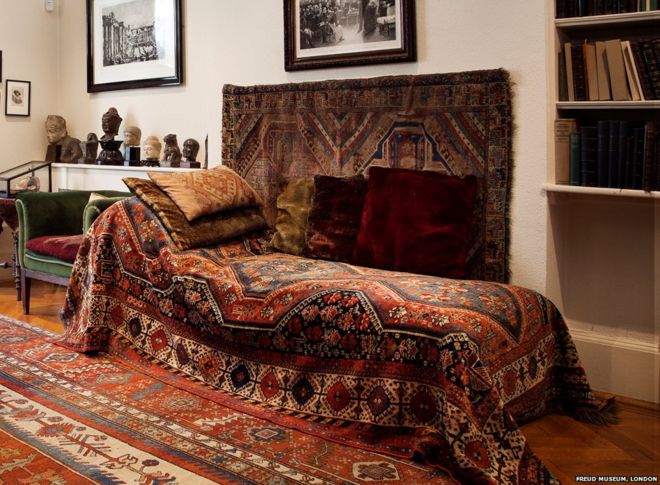 |
| How do you feel about your mother? |
Our rapidly changing sociopolitical environment leads a lot of people to seek out alternative spirituality. But if your sexuality doesn't really align to particular tradition, you're not going to get much out of it even if it appeals to you on intellectual principle.
Over the years, when I've lurked and occasionally posted on alternative spirituality forums, I've noticed a strong trend among those groups toward toward incorporating the Divine Feminine back into their consciousness and their lives. There seems to be a common assumption that the reason people seek out alternative spirituality is because that feminine aspect has been neglected by the western tradition, that the Patriarchy is the a priori reason why new and reconstructed traditions exist in the first place. This is true even in the nominally Christian-based Rosicrucian tradition, with its call to reintegrate with Divine Sophia. But as I alluded to in my post on The Heroine's Journey there isn't a "one size fits all" raison d'être for alternative seekers.
A question could be asked whether the continued predominance of traditional religion is not due, at least in some small part, to the fact that many people still feel more at home in it psycho-sexually than they would feel in alternative spirituality. If their cognitive dissonance resolves itself by siding with the unconscious sexual appeal of male dominance, they will stay put rather than taking the plunge into a tradition that's more in line with their actual philosophical perspective in the modern world, but which leaves them cold when it comes to their deepest sexual urges.
Needless to say, I think this is a false choice. Developing your own practice that is philosophically harmonious is much preferable, I think, even if it's driven by a desire for the Divine Masculine that isn't considered trendy in alternative circles.
Subscribe to:
Posts (Atom)