The four fundamental forces in physics are the strong nuclear force, the weak nuclear force, electromagnetism and gravity. Based on my experiences in meditation, I think if there is a metaphysical counterpart it might be called soul - not individual souls, but a cosmic soul as a fundamental force.
When it comes the question of consciousness, perhaps the cosmic soul is the software and the brain is the hardware. If you have the proper hardware, you can process the cosmic soul and you experience individual consciousness. Without the proper hardware, you wouldn't experience individual consciousness - just as if you didn't have mass, you wouldn't experience gravity on an individual level.
This leads to a sort of Spinozian conclusion that doesn't really allow for individualized immortality. It moves metaphysical reality into the realm of the universal and fundamental rather than the personal, so I'm sure it would never catch on as a major belief. It's not the answer most people want to hear. It's like arguing in the 15th century that the Earth isn't the center of the universe. But it's a possibility drawn from my own experiences.
Sunday, September 23, 2018

Friday, September 14, 2018
The Song of Neferankhet
I hesitated a bit to share this beyond a small circle. I'm a bit jealous of how nice it looks. But since I don't have any other posts prepared, here it is : The Song of Neferankhet papyrus.
This was conceived as a sort of Egyptian Song of Songs, an erotically charged spiritual metaphor. The nice thing, which evolved as the papyrus facsimile was being done, is how the horizontal and vertical lines combine to allude to the Egyptian logogram for "house", as if to illustrate that the speaker is seeking her spiritual home.

The main text reads: My beloved is the young god. He calls to me as sunlight calls to a new shoot. I follow him into the reed thicket. He warms me in his arms and my mouth embraces him. My boatman stirs the waters with his mighty oar, carrying me to the birthplace of the sun. Like grains of sand are the desires of men. They are blown beyond the horizon and forgotten. But like the flood are the kisses of my beloved, making bloom the lotus of the heart. Like the pillars of wisdom are his arms, like the scrolls of Thoth his words of love. Date wine flows from his lips. Like those from the sky he announces himself with light. Like a shapeless thought he comes upon me and I am freed from my body.
Underneath the Eye of Horus the text reads: Neferankhet seeking her beloved
This was conceived as a sort of Egyptian Song of Songs, an erotically charged spiritual metaphor. The nice thing, which evolved as the papyrus facsimile was being done, is how the horizontal and vertical lines combine to allude to the Egyptian logogram for "house", as if to illustrate that the speaker is seeking her spiritual home.

The main text reads: My beloved is the young god. He calls to me as sunlight calls to a new shoot. I follow him into the reed thicket. He warms me in his arms and my mouth embraces him. My boatman stirs the waters with his mighty oar, carrying me to the birthplace of the sun. Like grains of sand are the desires of men. They are blown beyond the horizon and forgotten. But like the flood are the kisses of my beloved, making bloom the lotus of the heart. Like the pillars of wisdom are his arms, like the scrolls of Thoth his words of love. Date wine flows from his lips. Like those from the sky he announces himself with light. Like a shapeless thought he comes upon me and I am freed from my body.
Underneath the Eye of Horus the text reads: Neferankhet seeking her beloved
Thursday, September 6, 2018
The Rosicrucian Quest Part 5
The third chapter of the Apocalypse of Thomas was particularly interesting to C.R.C. Its ontological vision goes against traditional Christian eschatology, expressing the idea that the material world is fundamentally imperfect, not because it was created by an imperfect Demiurge, but because, as C.R.C. wrote in his journal : Per medium coruſcans imperfecte ſpiritum Dei eſt. (It exists through a medium which imperfectly reflects the soul of God.)


3.5 But this was the spiritual image.
3.6 As we have see Christ with spiritual eyes, even so I saw these things.

3.1 I saw that the matter of the world is like a reflection on the water, and wickedness is like ripples on the reflection from the spirit ; but in the substance of the light there are no ripples.
3.2 For the Powers were moving through all things long before the beginning of aeons, and all that is not of the third body will pass away.
3.3 I saw a place with mountains of silver and of gold, and the rivers which flowed from those mountains were of pure water and honey.
3.4 And there were great sages whose spirits were occupied with investigation and learning, studying the emerald tablets of the Powers[continued on next page] and perfecting their knowledge of creation.

3.5 But this was the spiritual image.
3.6 As we have see Christ with spiritual eyes, even so I saw these things.
Sunday, September 2, 2018
The Rosicrucian Quest Part 4
As C.R.C. read the second chapter of the Apocalypse of Thomas he became even more intrigued by its symbolism, and he wrote in his journal, perhaps referring to what would come to be known as the Harbaville Triptych : Inaudior vt ſit triplex in Conſtantinopolis qui imaginem Roſæ Crucis
concipit. Illum video velim ſi pax cum Saracenis teneatur et
peregrinatio tuta ſit poſsibilis. (I have heard that there is a triptych in Constantinople which contains an image of a Rose Cross. I should like to see that, if the peace with the Saracens can be maintained and safe travel is possible.)


2.6 Likewise the second body is a vessel for the third body, which you must now fashion.
2.7 For man is born with the first body, and the second body enters into him on that day, but the third body he knows not.
2.8 Even that which you have seen in visions, which you call the Christ, the same is the third body.
2.9 It is of man, yet has no beginning ; it is of fire, yet does not consume [continued next page] nor does it fade.

2.10 And I saw within myself the golden cross, and I myself was the rose in union with it.
2.11 This was the symbol with which I was to imprint myself, inscribing it spiritually on my body, on my lips and my brow, on my fingernails and over my heart, for the realization of the third self.

2.1 Then I found myself in the midst of a red desert, and the desert reached to the horizon, and that was the desert of war.
2.2 And the Messenger said to me : Here water once flowed, carving great valleys, but now there is no life here.
2.3 And I saw that there were no moving things, and nothing green. Kindness passed like a fleeting shadow, and everywhere was desolation.
2.4 I saw mountains roaming the skies beyond the desolation, full of fire and unknowable tidings, and the abode of love was as the furnace of Hephaestus.
2.5 I wept for the flesh, which I thought to be [continued next page] a curse upon man, but the Messenger said to me : Weep not for the first body, being the body of flesh, for it is only a vessel for the second body, which you call spirit.
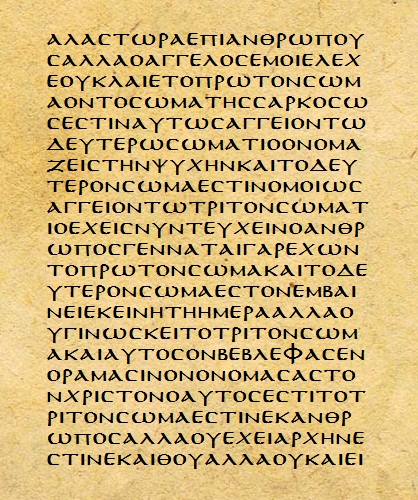
2.6 Likewise the second body is a vessel for the third body, which you must now fashion.
2.7 For man is born with the first body, and the second body enters into him on that day, but the third body he knows not.
2.8 Even that which you have seen in visions, which you call the Christ, the same is the third body.
2.9 It is of man, yet has no beginning ; it is of fire, yet does not consume [continued next page] nor does it fade.

2.10 And I saw within myself the golden cross, and I myself was the rose in union with it.
2.11 This was the symbol with which I was to imprint myself, inscribing it spiritually on my body, on my lips and my brow, on my fingernails and over my heart, for the realization of the third self.
Friday, August 31, 2018
The Rosicrucian Quest Part 3
The Egyptian monks with whom C.R.C. had become acquainted proceeded to show him another text, the "Apocalypse of Thomas" the Apostle to India, an early Christian revelation with unmistakable Hermetic characteristics. About the first chapter presented below, C.R.C. wrote : Spero philoſophiam naturalem comperire demum obſervationes huius viſionis de mundo. (I hope that natural philosophy may one day verify the observations of this vision concerning the Cosmos.)

1.1 It was in India that I witnessed, among the followers of Sanatana Dharma, the celebration of the Sacred Marriage which lasts nine days, and the miraculous austerities of their saints, who told me of the guardians of the spheres, of their travels in the sky, and of the ancient wars they had waged.
1.2 For they were masters of the sky, and the Earth trembled before them : they melted the mountains of ice, and dried up the great river of legend, which was called the Sarasvati.

1.3 I was received among those saints, and I purified the air by burning spices in the sacred fire, as is their custom.
1.4 And it came to pass that a wind arose, and a voice in the wind, and the voice asked : Can it be said to the endless, here is where you end and I begin ?
1.5 That was the voice of the Messenger, and the number of the Messenger is seven years and seven days.
1.6 I felt my back arch painfully, and my spirit rose up, and I looked down upon my body.
1.7 And the wind carried my spirit even higher, so that I saw the curvature of the Earth, and the brightness of the Earth, which was surrounded by darkness.

1.8 And I saw that the sun was as bright as four suns, for I had been carried above the clouds.
1.9 The whole Earth turned, showing me places whereof no writings exist : the lost places, the empty places, and the lost tribes of men.
1.10 And the Messenger said : Behold the pyramids of the desert, and of the forest, and behold the temples of Asia from the time of the flood.
1.11 Thus I beheld the Pillars of Enoch, long concealed from human eyes.

1.1 It was in India that I witnessed, among the followers of Sanatana Dharma, the celebration of the Sacred Marriage which lasts nine days, and the miraculous austerities of their saints, who told me of the guardians of the spheres, of their travels in the sky, and of the ancient wars they had waged.
1.2 For they were masters of the sky, and the Earth trembled before them : they melted the mountains of ice, and dried up the great river of legend, which was called the Sarasvati.

1.3 I was received among those saints, and I purified the air by burning spices in the sacred fire, as is their custom.
1.4 And it came to pass that a wind arose, and a voice in the wind, and the voice asked : Can it be said to the endless, here is where you end and I begin ?
1.5 That was the voice of the Messenger, and the number of the Messenger is seven years and seven days.
1.6 I felt my back arch painfully, and my spirit rose up, and I looked down upon my body.
1.7 And the wind carried my spirit even higher, so that I saw the curvature of the Earth, and the brightness of the Earth, which was surrounded by darkness.

1.8 And I saw that the sun was as bright as four suns, for I had been carried above the clouds.
1.9 The whole Earth turned, showing me places whereof no writings exist : the lost places, the empty places, and the lost tribes of men.
1.10 And the Messenger said : Behold the pyramids of the desert, and of the forest, and behold the temples of Asia from the time of the flood.
1.11 Thus I beheld the Pillars of Enoch, long concealed from human eyes.
Tuesday, August 28, 2018
The Rosicrucian Quest Part 2
After his cryptic discovery in Greece, C.R.C. continued his journey in Egypt, where he met a group of monks who showed him an ancient papyrus. This, they told him, was part of a "Book of Sarah" concerning the Biblical matriarch's sojourn in Egypt three thousand years earlier.
C.R.C. was fascinated by the story, and wrote in his diary : Hæc theophania Sarae fidem ſuam in coniugio divino repræſentat. Depingitur aſpiciens aſteres Orionis ſignificans aſcendendum. (This theophany of Sarah depicts her belief in the Divine Marriage. She is shown facing the stars of Orion, symbolizing ascension.)
We can now display and translate the fragments of papyrus scroll that so interested him.

Sarai was conveyed to (or procured for) the house of the king, for she was beautiful and there was no husband who claimed her. She was with her brother Abram, but he was in fact her husband, and fearing violence he concealed this from them, lest they kill him in order to possess her. Thus Sarai went under the king's roof, but Abram they did not trouble, instead rewarding him.
Now the king saw Sarai and desired her greatly. He had her veiled in fine veils and brought unto him, but she resisted him. He made her to uncover her nakedness, and his eyes were fixed upon her, her skin shining like the moon, but still she would not lie with him.
Now this continued each night, and Sarai beseeched [Asherah daily to be returned to her husband.] - bracketed text translated from the beginning of the next page]

But Asherah appeared to her, saying : I have brought thee hither so that thou mayest learn the mysteries of Egypt. Therefore be not distressed, but say unto the king : Send unto me scribes that I may learn from them the ways of this land.
So Sarai said unto the king : An thou dost desire my happiness, being a kind lord, send unto me thy scribes so that they may teach me. Grant me to know thy ways as thou hast known my nakedness.
And he sent her scribes, and Sarai learned of them their writing, and the mysteries of stars and of forms, for to bring that knowledge back with her to Canaan....
C.R.C. was fascinated by the story, and wrote in his diary : Hæc theophania Sarae fidem ſuam in coniugio divino repræſentat. Depingitur aſpiciens aſteres Orionis ſignificans aſcendendum. (This theophany of Sarah depicts her belief in the Divine Marriage. She is shown facing the stars of Orion, symbolizing ascension.)
We can now display and translate the fragments of papyrus scroll that so interested him.

Sarai was conveyed to (or procured for) the house of the king, for she was beautiful and there was no husband who claimed her. She was with her brother Abram, but he was in fact her husband, and fearing violence he concealed this from them, lest they kill him in order to possess her. Thus Sarai went under the king's roof, but Abram they did not trouble, instead rewarding him.
Now the king saw Sarai and desired her greatly. He had her veiled in fine veils and brought unto him, but she resisted him. He made her to uncover her nakedness, and his eyes were fixed upon her, her skin shining like the moon, but still she would not lie with him.
Now this continued each night, and Sarai beseeched [Asherah daily to be returned to her husband.] - bracketed text translated from the beginning of the next page]

But Asherah appeared to her, saying : I have brought thee hither so that thou mayest learn the mysteries of Egypt. Therefore be not distressed, but say unto the king : Send unto me scribes that I may learn from them the ways of this land.
So Sarai said unto the king : An thou dost desire my happiness, being a kind lord, send unto me thy scribes so that they may teach me. Grant me to know thy ways as thou hast known my nakedness.
And he sent her scribes, and Sarai learned of them their writing, and the mysteries of stars and of forms, for to bring that knowledge back with her to Canaan....
Sunday, August 26, 2018
The Rosicrucian Quest Part 1
I'm beginning a new series, imagining texts that Christian Rosenkreuz might have come across when searching for lost mysteries during his journeys in the East.
First up, in Greece, C.R.C. discovered a tablet fragment inscribed with indecipherable characters. He made a drawing of these characters in a diary that he began to keep. This diary was later typeset and copies were distributed to select Brothers and Sisters.
The typeset copies also included a facsimile of the unrecognizable script, in the hopes that the Brothers and Sisters might be able to someday translate it. The facsimile appears thus, with C.R.C.'s diary entry below :


First up, in Greece, C.R.C. discovered a tablet fragment inscribed with indecipherable characters. He made a drawing of these characters in a diary that he began to keep. This diary was later typeset and copies were distributed to select Brothers and Sisters.
The typeset copies also included a facsimile of the unrecognizable script, in the hopes that the Brothers and Sisters might be able to someday translate it. The facsimile appears thus, with C.R.C.'s diary entry below :

Credo has fuiſse litteræ Enochi. Non eſt dubium vt ſint multum
anticæ
quoniam nemo ne inter eruditiſsimos quidem illas legere
poteſt.
I believe these to have been the letters of Enoch. There is no doubt that they are
very old since no one, not even among the most learned, is able to read them.
A later Brother, identified as Fr I.D., noticed a particular sequence of four symbols that occurs twice in the short text :

Taking his cue from C.R.C.'s hypothesis concerning the origin of the characters, Brother I.D. proposed that these might be the Adamic characters equivalent to the Hebrew אדני (Adonai) but in this he was mistaken. We now know that the script is Linear B, and the four characters highlighted by Brother I.D. can be read as e-ru-ku-te, likely a cognate of the later Greek ειρκτή (prison).
The full inscription can be read : Whereas some say the body was created as a prison for the soul, I ask, is the nest a prison for the bird ?
This esoteric question surely would've intrigued C.R.C. had he been able to decipher it.
Subscribe to:
Posts (Atom)