My girlfriend has said that believing in a soul is like believing in a flat Earth. It just doesn't jive with modern knowledge. For example, how would a soul experience sensory input without a nervous system? How would a soul have thoughts and memories without a brain?
Given my own experience with meditation, I would say that physical and mental processes are purely mechanical. Thus they do not represent the true Self. So what is the Self?
If it exists at all, I think the Self is not a soul, it's simply being. That's what spiritual emptiness means. It's not annihilation of the Self, it's the Self as distinct from thoughts and desires, distinct from all mechanical processes - an emptiness of everything that is not the Self.
Friday, June 7, 2019

Saturday, May 18, 2019
Malias - Page 3
The third page of the Maliad. The poem is 61 lines long now, and I've reached the critical moment of the first scene.

Then rising to his feet, Kameus said to the men: The temples have vast riches from the gifts that they receive, those golden labryses and many herd animals. Why do they deny me a just portion as a tribute? For the sky and the wind have no need of such things. Therefore let her go and bring me my just due!
Some nodded in approval, for indeed his store rooms were full of the things they had brought, olive oil and wine, prized ivory from Libya and other kinds of goods; and the halls of the palace smelled of their cooked sacrifices. They had given generously, so why should the temples hold back?
But gray-haired Dionides came forward and said: Man cannot take that which was offered to the gods, nay, however much he may desire it, lest they become angry with him and punish him for his hubris.
And Teliassa said: Hear now, Kameus, the words of wise Dionides, and do not hunger for that which is above you, for you are but a king and dust before the gods.
Now Kameus was furious, his pride wounded, and he said: Behold now, brethren, if she does not give me wealth from the temple, then I will take what she did bring!

Then rising to his feet, Kameus said to the men: The temples have vast riches from the gifts that they receive, those golden labryses and many herd animals. Why do they deny me a just portion as a tribute? For the sky and the wind have no need of such things. Therefore let her go and bring me my just due!
Some nodded in approval, for indeed his store rooms were full of the things they had brought, olive oil and wine, prized ivory from Libya and other kinds of goods; and the halls of the palace smelled of their cooked sacrifices. They had given generously, so why should the temples hold back?
But gray-haired Dionides came forward and said: Man cannot take that which was offered to the gods, nay, however much he may desire it, lest they become angry with him and punish him for his hubris.
And Teliassa said: Hear now, Kameus, the words of wise Dionides, and do not hunger for that which is above you, for you are but a king and dust before the gods.
Now Kameus was furious, his pride wounded, and he said: Behold now, brethren, if she does not give me wealth from the temple, then I will take what she did bring!
Friday, May 10, 2019
Koan and Rosicrucianism
An addendum to my last post. One of the goals of Rosicrucian study is developing your intuition, and intuition is key to the Zen koan. These are questions that you can't answer through conscious reasoning. You have to meditate on them until an intuitive answer comes into your mind.
Working out the meaning of the answer (and thus, of the question itself) can lead to a satori (悟り) or moment of understanding, moment of awakening.
In short, this is why I think Zen practice and Rosicrucian study can complement each other.
I'm not learned enough to say that it would be a mistake to do Rosicrucian study without other tools to maximize the benefit, but I would strongly encourage Zen for that purpose, both to get the most out of Rosicrucian study and to help you remain critical of Rosicurcian materials as you progress. There's a particular ontological framework in the Rosicrucian tradition, but it shouldn't be blindly absorbed with religiosity. Instead, it should be examined critically and experimentally, and this is a benefit of the Zen approach.
Working out the meaning of the answer (and thus, of the question itself) can lead to a satori (悟り) or moment of understanding, moment of awakening.
In short, this is why I think Zen practice and Rosicrucian study can complement each other.
I'm not learned enough to say that it would be a mistake to do Rosicrucian study without other tools to maximize the benefit, but I would strongly encourage Zen for that purpose, both to get the most out of Rosicrucian study and to help you remain critical of Rosicurcian materials as you progress. There's a particular ontological framework in the Rosicrucian tradition, but it shouldn't be blindly absorbed with religiosity. Instead, it should be examined critically and experimentally, and this is a benefit of the Zen approach.
Wednesday, May 8, 2019
Koan practice
One of the most famous Zen koans is "If a tree falls in the forest and no one is there to hear it, does it make a sound?" It's so well known the people don't really take it seriously, but in fact I find it to be one of the more difficult koans to grapple with. It takes real effort, and is well deserving of its prominence within the 'effort school' of Zen.
An answer I came up with while meditating on it is: "A picture of my grandmother after my grandfather died."
That ended up being literally a vertigo-inducing answer. What the koan was really pointing me toward was the question of contingency, and the realization that my existence is not contingent on my grandparents. That's actually quite scary. It's a realization that pulls out from under you a foundational element of your concept of self. It begs the question: What is my existence if it's not contingent on them?
Quite often, spiritual practice doesn't bring you peace, but exactly the opposite. It deprives you of concepts which seem stable, and leaves you with nothing in their place except the hard task of making peace with a non-conceptual answer.
An answer I came up with while meditating on it is: "A picture of my grandmother after my grandfather died."
That ended up being literally a vertigo-inducing answer. What the koan was really pointing me toward was the question of contingency, and the realization that my existence is not contingent on my grandparents. That's actually quite scary. It's a realization that pulls out from under you a foundational element of your concept of self. It begs the question: What is my existence if it's not contingent on them?
Quite often, spiritual practice doesn't bring you peace, but exactly the opposite. It deprives you of concepts which seem stable, and leaves you with nothing in their place except the hard task of making peace with a non-conceptual answer.
Tuesday, May 7, 2019
Malias - Page 2
Here is the second page of the Malias. If you read the first page, you should note that I made a change to it - I changed the somewhat anachronistic name Alexius to the older Adamaos, a name attested in Linear B script.

Now fiery-haired Teliassa, priestess of the temple on the mountain where Zeus was born, entered the palace dressed in a gown with sparkling purple trim. She wore an iron armlet in the form of a serpent, and sandals stitched with cloth of silver. All eyes were upon her; women, envious of her great beauty, chatted in the corners, and men watched her with ravenous looks. She approached the alabaster throne with a regal gait, her gaze fixed on Kameus, and said: I offer you honors from those who serve the gods, Zeus and Hera, and Poseidon and Posideia, Hermes and well-girdled Aphrodite.
Nearby, Adamaos was staring at Teliassa as if struck by the arrow, for indeed he was, standing mute on the spot where love had overcome him.
The king too was struck by desire, but desire of another kind. He wrung his bear-like hands and said: I see you have the richest clothes, and an armlet more valuable than gold¹; yet in spite of your wealth, you bring me only words.
¹ In the bronze age, iron was extremely difficult to produce and was therefore more valuable than gold

Now fiery-haired Teliassa, priestess of the temple on the mountain where Zeus was born, entered the palace dressed in a gown with sparkling purple trim. She wore an iron armlet in the form of a serpent, and sandals stitched with cloth of silver. All eyes were upon her; women, envious of her great beauty, chatted in the corners, and men watched her with ravenous looks. She approached the alabaster throne with a regal gait, her gaze fixed on Kameus, and said: I offer you honors from those who serve the gods, Zeus and Hera, and Poseidon and Posideia, Hermes and well-girdled Aphrodite.
Nearby, Adamaos was staring at Teliassa as if struck by the arrow, for indeed he was, standing mute on the spot where love had overcome him.
The king too was struck by desire, but desire of another kind. He wrung his bear-like hands and said: I see you have the richest clothes, and an armlet more valuable than gold¹; yet in spite of your wealth, you bring me only words.
¹ In the bronze age, iron was extremely difficult to produce and was therefore more valuable than gold
Tuesday, April 30, 2019
Malias - Page 1
So here is the completed first page of the Malias Papyrus.

Sing, O Heaven, the heart of fiery-haired Teliassa, who brought about the downfall of the tyrant Kameus. What frightful, divine force could wreak such damage as befell the unfortunate Cretans? Indeed, only the most powerful of any that are known - love.
The goddess of seduction stirs the soul like wind upon the water, and changes the shape of our world forever. Thus it was for Malia on the night when King Kameus assumed the crown, carousing with men of renown and nobles from the surrounding lands.
Gray-haired Dionides was there, who had offered the hecatomb to all the gods, praying for their blessing and for a long and peaceful reign, alas but in vain; and bronze-skinned Alexius, who leaped over bulls with the aerial grace of a soaring kite; and great captains of ships which swiftly sailed the mercurial sea, laden with riches, and others whose names are now forgotten, feasting on the roasted meat by the light of the braziers.

Sing, O Heaven, the heart of fiery-haired Teliassa, who brought about the downfall of the tyrant Kameus. What frightful, divine force could wreak such damage as befell the unfortunate Cretans? Indeed, only the most powerful of any that are known - love.
The goddess of seduction stirs the soul like wind upon the water, and changes the shape of our world forever. Thus it was for Malia on the night when King Kameus assumed the crown, carousing with men of renown and nobles from the surrounding lands.
Gray-haired Dionides was there, who had offered the hecatomb to all the gods, praying for their blessing and for a long and peaceful reign, alas but in vain; and bronze-skinned Alexius, who leaped over bulls with the aerial grace of a soaring kite; and great captains of ships which swiftly sailed the mercurial sea, laden with riches, and others whose names are now forgotten, feasting on the roasted meat by the light of the braziers.
Sunday, April 28, 2019
Front page news - from 1650 BC
In case you were wondering whether I'd given up my ancient language fanfic, the answer is no. I've been plugging away at it from time to time, and I think I've finally (!) got an opening I'm happy with.
The piece is tentatively called Malias i.e. the Song of Malia, even though the place wouldn't have been called that in the Bronze Age. (No one knows that the Minoans called it.)
Here are the opening verses:

It reads:
Sing, O Heaven, the heart of fiery-haired Teliassa, who brought about the downfall of the tyrant Kameus.
What frightful, divine force could wreak such damage as befell the unfortunate Cretans? Indeed, only the most powerful of any that are known - love.
The goddess of seduction stirs the soul like wind upon the water, and changes the shape of our world forever. Thus it was for Malia on the night when King Kameus assumed the crown, carousing with men of renown and nobles from the surrounding lands....
(What should follow is a roll call of people present at the coronation feast, because every epic needs a roll call. And after that comes the incident that dooms the city.)
The piece is tentatively called Malias i.e. the Song of Malia, even though the place wouldn't have been called that in the Bronze Age. (No one knows that the Minoans called it.)
Here are the opening verses:

It reads:
Sing, O Heaven, the heart of fiery-haired Teliassa, who brought about the downfall of the tyrant Kameus.
What frightful, divine force could wreak such damage as befell the unfortunate Cretans? Indeed, only the most powerful of any that are known - love.
The goddess of seduction stirs the soul like wind upon the water, and changes the shape of our world forever. Thus it was for Malia on the night when King Kameus assumed the crown, carousing with men of renown and nobles from the surrounding lands....
(What should follow is a roll call of people present at the coronation feast, because every epic needs a roll call. And after that comes the incident that dooms the city.)
Friday, April 26, 2019
The unquiet mind
I've been crap at meditating recently. Unable to concentrate, unable to quiet the mind.
I did experience some minor success when I tried meditating with an arm raised. At the point the arm becomes tired, the mind has to fight against it. But with some persistence, the mind can become indifferent to the strain. Still, not much to show for it.
I feel blocked and chaotic, but I continue to meditate daily because when all else fails, keep practicing.
I'm also trying to finish up the first degree of my CR+C studies which lagged behind over the winter. There's quite a lot of material, but few practical experiments, and those have been mostly fruitless for me. On the other hand, I do appreciate the structure, which is something I don't naturally create for myself.
I'd have to say I'm about 3/10 in terms of my practice at the moment, and not from lack of trying. Overcoming obstacles is not something I'm good at. If I can't just go around them, I get stuck. If I can't be superlative, I just spin my wheels. So I'm trying to think of showing some discipline as success in its own right.
I did experience some minor success when I tried meditating with an arm raised. At the point the arm becomes tired, the mind has to fight against it. But with some persistence, the mind can become indifferent to the strain. Still, not much to show for it.
I feel blocked and chaotic, but I continue to meditate daily because when all else fails, keep practicing.
I'm also trying to finish up the first degree of my CR+C studies which lagged behind over the winter. There's quite a lot of material, but few practical experiments, and those have been mostly fruitless for me. On the other hand, I do appreciate the structure, which is something I don't naturally create for myself.
I'd have to say I'm about 3/10 in terms of my practice at the moment, and not from lack of trying. Overcoming obstacles is not something I'm good at. If I can't just go around them, I get stuck. If I can't be superlative, I just spin my wheels. So I'm trying to think of showing some discipline as success in its own right.
Friday, March 15, 2019
Detachment and Compassion
The other day I was meditating and an image of a flower came to mind, complete with its lovely fragrance. Once I inhaled deeply to savor the aroma, the flower suddenly changed to a dead animal, complete with the odor of decomposition.
I realized that in fact neither state should necessarily be preferred over the other. Everything changes. Nothing permanently remains as it is.
But I also realized something else. That awareness of detaching oneself, of being indifferent to the changes, brought up a sense of great compassion.
It seems paradoxical to talk about indifference and compassion as being intimately linked, but I think they are. When you experience indifference to the inevitable cycle of change, you also experience compassion for the system as a whole, a kind of universal compassion that's inaccessible while you're holding onto an egoistic desire to hold onto things as you want them to be.
I realized that in fact neither state should necessarily be preferred over the other. Everything changes. Nothing permanently remains as it is.
But I also realized something else. That awareness of detaching oneself, of being indifferent to the changes, brought up a sense of great compassion.
It seems paradoxical to talk about indifference and compassion as being intimately linked, but I think they are. When you experience indifference to the inevitable cycle of change, you also experience compassion for the system as a whole, a kind of universal compassion that's inaccessible while you're holding onto an egoistic desire to hold onto things as you want them to be.
Friday, December 14, 2018
The First Rosicrucian
 I googled "first rosicrucian" and the first like that popped up said "Understanding reincarnation" which leads me to the topic of today's post: Pythagoras.
He is primarily remembered today for his theorem concerning right triangles, but the history (mostly mythology, actually) of Pythagoras goes much deeper than that.
As a seeker of knowledge, he did not seem to distinguish between empirical and mystical ideas, and he was said to have been very keen to learn from cultures older than his native Ionian Greek civilization. Hence he traveled to Egypt and, it is claimed, to India.
An Indic concept of reincarnation first enters recorded western thought through the Pythagoreans, along with the concept of the monad or brahman as the source of all creation. If Pythagoras was not a real, historical individual, it certainly seems that the character must have been based on one or more real people who were exposed in some depth to the Vedic tradition and brought its ideas back to the West - kicking off a cycle of historical and legendary Westerners periodically "rediscovering" the knowledge of the East, from Pythagoras to Christian Rosenkreuz to Mme. Blavatsky to the Beatles.
Sunday, December 9, 2018
Astrological Signs
I wanted to include an astrological reference in my Trojan War story, so I went digging for info. It turns out there is something that fits the narrative at around about the right time.
When Teliassa sets out for Troy, about six months before the end of the war, a quarter moon rises in Sagittarius. It's the end of October, 1185 BC - a time of change and danger for Teliassa the archer....
When Teliassa sets out for Troy, about six months before the end of the war, a quarter moon rises in Sagittarius. It's the end of October, 1185 BC - a time of change and danger for Teliassa the archer....
Trojan War Epic: Page 1 Revisited
A revised Page 1 that gets straight to the source of Teliassa's later drama :

Sing, O Muses, the heart of fiery-haired Teliassa, the keen-eyed daughter of Caprias, who longed to wet her trusty arrows in the well of Trojan misery. For the men of Ilium had killed her father, that celebrated Larissan who had sailed with Achilles.
A fierce warrior was Caprias, but in the end he fell, surrounded by many foes, the stench of cloven entrails thick in the dusty air. Indeed he had afflicted the defenders of the Troad grievously before his death.

Thus having spoken, she called for a long-horned ram and sacrificed it, eating its eyes and tongue as if they were those of her accursed enemy, promising before the gods to repay the Trojans in kind.
Now, Ares favored Troy, but he was struck by the fervid maiden's desire for vengeance, and he granted her a boon, a peerless bow of yew wood inlaid with silver, saying: The beauty of this weapon is matched only by your own!
Teliassa resisted his advances, but Ares' interest in her aroused the infamous jealousy of Aphrodite, and she swore to revenge herself on the Aeolian girl.
Friday, December 7, 2018
Tricks of the Trade
In working on my Trojan war story, I've got the phrase ὡς δ’ ἤκουσε ἕθεν (and when she heard of it) which can be written in a couple of ways. The normal way would be to contract ἤκουσε ἕθεν to ἤκουσ’ ἕθεν. But in Aeolian Greek, the genitive object would be ϝέθεν with the digamma. And even when the digamma disappears from writing, its pronunciation can still be indicated by writing the phrase as ἤκουσε έθεν.
Tricks of the trade in a 3,000 year old language.
Tricks of the trade in a 3,000 year old language.
Tuesday, November 27, 2018
Trojan Epic Page 1
Been a while since I posted, but here's some of what I've been working on, a Trojan war narrative in Homeric verse.

Sing, O Heaven, the heart of fiery-haired Teliassa whose love for her father brought her to the walls of Ilium, for Caprias son of Dion was slain by the Trojans, that celebrated Larissan, sire of the fierce maiden who swore to avenge his blood in war.
Now when Teliassa arrived at the Achaean camp, the men marveled at her appearance, which was like an Amazon's, her eyes dark with the stare of one who has seen slaughter. Indeed she was not the same child who was left behind when her father sailed for Troy with Achilles, watching from shore as the ship vanished beyond the horizon. The gods had led her far and wide ere she could reach the city of Priam, site of her father's demise.
Before leaving Aeolia, she had sacrificed a fine goat to the sun god, her ancestor, and she ate its eyes and tongue, saying: May Troy not see victory, nor sing the glory of its accursed heroes!

Sing, O Heaven, the heart of fiery-haired Teliassa whose love for her father brought her to the walls of Ilium, for Caprias son of Dion was slain by the Trojans, that celebrated Larissan, sire of the fierce maiden who swore to avenge his blood in war.
Now when Teliassa arrived at the Achaean camp, the men marveled at her appearance, which was like an Amazon's, her eyes dark with the stare of one who has seen slaughter. Indeed she was not the same child who was left behind when her father sailed for Troy with Achilles, watching from shore as the ship vanished beyond the horizon. The gods had led her far and wide ere she could reach the city of Priam, site of her father's demise.
Before leaving Aeolia, she had sacrificed a fine goat to the sun god, her ancestor, and she ate its eyes and tongue, saying: May Troy not see victory, nor sing the glory of its accursed heroes!
Saturday, October 27, 2018
Was Göbekli Tepe Atlantis?
Here's my case that the Göbekli Tepe civilization was Atlantis.
1) It dates from the time of Atlantis.
2) The ancient Egyptians (from whom Solon and hence Plato supposedly got the story) had an upside down view of geography. Because the Nile flows from south to north, the Egyptians thought of the south as geographic "up" and the north as "down". So for them, Atlantis was towards the left of Greece.
3) A civilization of the Göbekli Tepe builders in the Black Sea area could have come into conflict with a Proto-Pelasgian culture in the area of Greece and the Balkans.
4) Both the Greek peninsula and the Black Sea area suffered catastrophic coastal flooding after the end of the last ice age.
5) Atlantis as described by Plato featured a large stone pillar as its cultural center, and the Göbekli Tepe civilization is known for its ... large stone pillars.
So is the war against Atlantis in Plato's dialogue really a neolithic Trojan War?
1) It dates from the time of Atlantis.
2) The ancient Egyptians (from whom Solon and hence Plato supposedly got the story) had an upside down view of geography. Because the Nile flows from south to north, the Egyptians thought of the south as geographic "up" and the north as "down". So for them, Atlantis was towards the left of Greece.
3) A civilization of the Göbekli Tepe builders in the Black Sea area could have come into conflict with a Proto-Pelasgian culture in the area of Greece and the Balkans.
4) Both the Greek peninsula and the Black Sea area suffered catastrophic coastal flooding after the end of the last ice age.
5) Atlantis as described by Plato featured a large stone pillar as its cultural center, and the Göbekli Tepe civilization is known for its ... large stone pillars.
So is the war against Atlantis in Plato's dialogue really a neolithic Trojan War?
Sunday, October 7, 2018
The Many Faces of Dionysus
In the ancient Dionysian festivals there would be a particular mythic theme, and various tragic, comic and pastoral works would be presented which all drew from the same myth.
I have an opening line that goes like this:
I have an opening line that goes like this:
ΟΙ ΒΛΕΡΟΙΣΙ ΤΑ ΠΑΝΤΑ ΘΕΟΙ ΟΥ ΛΑΝΘΑΝΟΝΤΑΙ ΔΕ ΤΩΝ ΕΒΛΕΦΕΝΤΩΝ
The gods see all things, and they do not forget the things they have seen.
This line could be the opening for stories in any of three classical modes. Right now I'm working on the tragic, in which case the line can be read as a warning: The gods see all things, and they recompense you accordingly.
Sunday, September 23, 2018
The Fifth Force
The four fundamental forces in physics are the strong nuclear force, the weak nuclear force, electromagnetism and gravity. Based on my experiences in meditation, I think if there is a metaphysical counterpart it might be called soul - not individual souls, but a cosmic soul as a fundamental force.
When it comes the question of consciousness, perhaps the cosmic soul is the software and the brain is the hardware. If you have the proper hardware, you can process the cosmic soul and you experience individual consciousness. Without the proper hardware, you wouldn't experience individual consciousness - just as if you didn't have mass, you wouldn't experience gravity on an individual level.
This leads to a sort of Spinozian conclusion that doesn't really allow for individualized immortality. It moves metaphysical reality into the realm of the universal and fundamental rather than the personal, so I'm sure it would never catch on as a major belief. It's not the answer most people want to hear. It's like arguing in the 15th century that the Earth isn't the center of the universe. But it's a possibility drawn from my own experiences.
When it comes the question of consciousness, perhaps the cosmic soul is the software and the brain is the hardware. If you have the proper hardware, you can process the cosmic soul and you experience individual consciousness. Without the proper hardware, you wouldn't experience individual consciousness - just as if you didn't have mass, you wouldn't experience gravity on an individual level.
This leads to a sort of Spinozian conclusion that doesn't really allow for individualized immortality. It moves metaphysical reality into the realm of the universal and fundamental rather than the personal, so I'm sure it would never catch on as a major belief. It's not the answer most people want to hear. It's like arguing in the 15th century that the Earth isn't the center of the universe. But it's a possibility drawn from my own experiences.
Friday, September 14, 2018
The Song of Neferankhet
I hesitated a bit to share this beyond a small circle. I'm a bit jealous of how nice it looks. But since I don't have any other posts prepared, here it is : The Song of Neferankhet papyrus.
This was conceived as a sort of Egyptian Song of Songs, an erotically charged spiritual metaphor. The nice thing, which evolved as the papyrus facsimile was being done, is how the horizontal and vertical lines combine to allude to the Egyptian logogram for "house", as if to illustrate that the speaker is seeking her spiritual home.

The main text reads: My beloved is the young god. He calls to me as sunlight calls to a new shoot. I follow him into the reed thicket. He warms me in his arms and my mouth embraces him. My boatman stirs the waters with his mighty oar, carrying me to the birthplace of the sun. Like grains of sand are the desires of men. They are blown beyond the horizon and forgotten. But like the flood are the kisses of my beloved, making bloom the lotus of the heart. Like the pillars of wisdom are his arms, like the scrolls of Thoth his words of love. Date wine flows from his lips. Like those from the sky he announces himself with light. Like a shapeless thought he comes upon me and I am freed from my body.
Underneath the Eye of Horus the text reads: Neferankhet seeking her beloved
This was conceived as a sort of Egyptian Song of Songs, an erotically charged spiritual metaphor. The nice thing, which evolved as the papyrus facsimile was being done, is how the horizontal and vertical lines combine to allude to the Egyptian logogram for "house", as if to illustrate that the speaker is seeking her spiritual home.

The main text reads: My beloved is the young god. He calls to me as sunlight calls to a new shoot. I follow him into the reed thicket. He warms me in his arms and my mouth embraces him. My boatman stirs the waters with his mighty oar, carrying me to the birthplace of the sun. Like grains of sand are the desires of men. They are blown beyond the horizon and forgotten. But like the flood are the kisses of my beloved, making bloom the lotus of the heart. Like the pillars of wisdom are his arms, like the scrolls of Thoth his words of love. Date wine flows from his lips. Like those from the sky he announces himself with light. Like a shapeless thought he comes upon me and I am freed from my body.
Underneath the Eye of Horus the text reads: Neferankhet seeking her beloved
Thursday, September 6, 2018
The Rosicrucian Quest Part 5
The third chapter of the Apocalypse of Thomas was particularly interesting to C.R.C. Its ontological vision goes against traditional Christian eschatology, expressing the idea that the material world is fundamentally imperfect, not because it was created by an imperfect Demiurge, but because, as C.R.C. wrote in his journal : Per medium coruſcans imperfecte ſpiritum Dei eſt. (It exists through a medium which imperfectly reflects the soul of God.)


3.5 But this was the spiritual image.
3.6 As we have see Christ with spiritual eyes, even so I saw these things.

3.1 I saw that the matter of the world is like a reflection on the water, and wickedness is like ripples on the reflection from the spirit ; but in the substance of the light there are no ripples.
3.2 For the Powers were moving through all things long before the beginning of aeons, and all that is not of the third body will pass away.
3.3 I saw a place with mountains of silver and of gold, and the rivers which flowed from those mountains were of pure water and honey.
3.4 And there were great sages whose spirits were occupied with investigation and learning, studying the emerald tablets of the Powers[continued on next page] and perfecting their knowledge of creation.

3.5 But this was the spiritual image.
3.6 As we have see Christ with spiritual eyes, even so I saw these things.
Sunday, September 2, 2018
The Rosicrucian Quest Part 4
As C.R.C. read the second chapter of the Apocalypse of Thomas he became even more intrigued by its symbolism, and he wrote in his journal, perhaps referring to what would come to be known as the Harbaville Triptych : Inaudior vt ſit triplex in Conſtantinopolis qui imaginem Roſæ Crucis
concipit. Illum video velim ſi pax cum Saracenis teneatur et
peregrinatio tuta ſit poſsibilis. (I have heard that there is a triptych in Constantinople which contains an image of a Rose Cross. I should like to see that, if the peace with the Saracens can be maintained and safe travel is possible.)


2.6 Likewise the second body is a vessel for the third body, which you must now fashion.
2.7 For man is born with the first body, and the second body enters into him on that day, but the third body he knows not.
2.8 Even that which you have seen in visions, which you call the Christ, the same is the third body.
2.9 It is of man, yet has no beginning ; it is of fire, yet does not consume [continued next page] nor does it fade.

2.10 And I saw within myself the golden cross, and I myself was the rose in union with it.
2.11 This was the symbol with which I was to imprint myself, inscribing it spiritually on my body, on my lips and my brow, on my fingernails and over my heart, for the realization of the third self.

2.1 Then I found myself in the midst of a red desert, and the desert reached to the horizon, and that was the desert of war.
2.2 And the Messenger said to me : Here water once flowed, carving great valleys, but now there is no life here.
2.3 And I saw that there were no moving things, and nothing green. Kindness passed like a fleeting shadow, and everywhere was desolation.
2.4 I saw mountains roaming the skies beyond the desolation, full of fire and unknowable tidings, and the abode of love was as the furnace of Hephaestus.
2.5 I wept for the flesh, which I thought to be [continued next page] a curse upon man, but the Messenger said to me : Weep not for the first body, being the body of flesh, for it is only a vessel for the second body, which you call spirit.
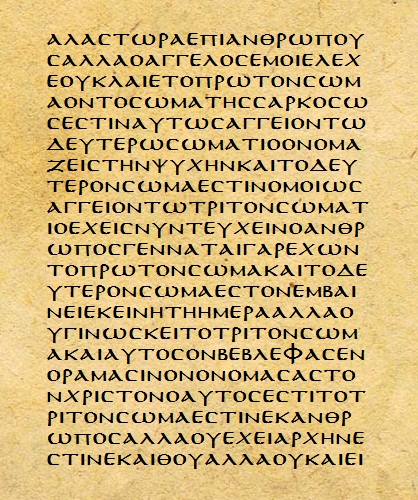
2.6 Likewise the second body is a vessel for the third body, which you must now fashion.
2.7 For man is born with the first body, and the second body enters into him on that day, but the third body he knows not.
2.8 Even that which you have seen in visions, which you call the Christ, the same is the third body.
2.9 It is of man, yet has no beginning ; it is of fire, yet does not consume [continued next page] nor does it fade.

2.10 And I saw within myself the golden cross, and I myself was the rose in union with it.
2.11 This was the symbol with which I was to imprint myself, inscribing it spiritually on my body, on my lips and my brow, on my fingernails and over my heart, for the realization of the third self.
Subscribe to:
Posts (Atom)